

Google Ads vs Local SEO for Plumbers: What Actually Works in 2026
If you own a plumbing company, you have probably asked yourself the same question a hundred times: should I pay for Google Ads or put that money into local SEO? The honest answer is that you need both, but not in equal amounts, and not at the same time. The right mix depends on how fast you need the phone to ring, how long you plan to be in business, and what your monthly budget can realistically handle.
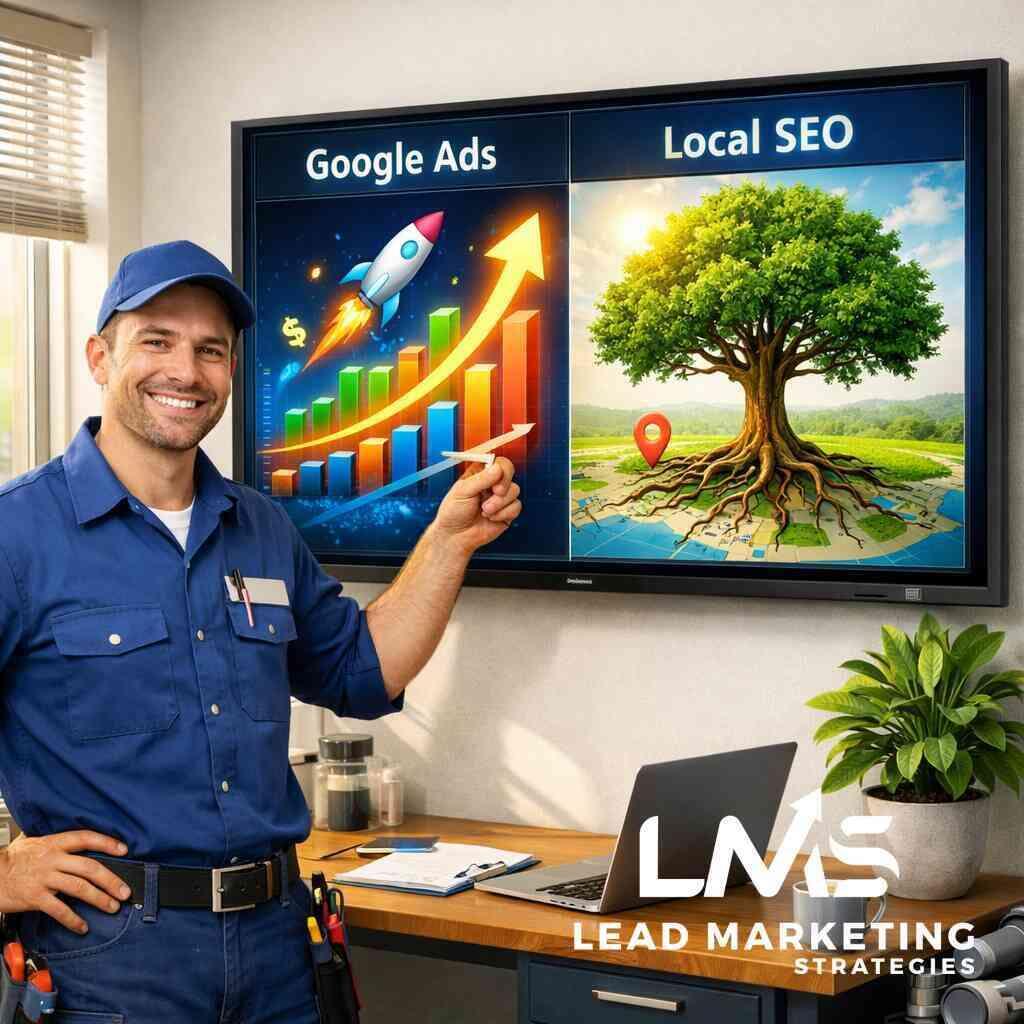
Short answer: Google Ads and Local Services Ads generate calls within days, while local SEO builds a durable asset that lowers your cost per lead over time. Start paid if you need jobs now. Build local SEO from day one regardless. In our experience, plumbers who lean on one and ignore the other either burn cash on clicks forever or wait too long for organic traction.
This comparison of Google Ads vs local SEO for plumbers breaks down real cost per lead, timelines, and the budget splits we recommend so you can stop guessing and start booking more jobs.
What is the difference between Google Ads and local SEO for plumbers?
Google Ads are paid placements you rent. Local SEO is visibility you own. Ads put you at the top of search results today and stop the moment you quit paying. Local SEO builds your Google Business Profile, service pages, reviews, and citations so you show up in the Local Pack and Maps for free, month after month.
One is a faucet you turn on. The other is a well you dig. The smartest plumbing companies run both, with paid covering the gaps while organic authority compounds.
The three placements that matter on a plumbing search result
When someone searches “emergency plumber near me,” the results page is crowded. Three things compete for the click:
- Local Services Ads (LSAs): The “Google Screened” box at the very top, pay per valid lead.
- Google Search Ads: Traditional sponsored text ads, pay per click.
- The Local Pack: The map with three plumbing businesses, driven by your Google Business Profile and local SEO.
If you are only showing up in one of those three, you are handing calls to competitors who show up in all three. Covering the full screen is the whole game.
Should a brand-new plumbing company start with Google Ads or SEO?
Start with Google Ads and Local Services Ads. Local SEO takes 90 to 180 days to gain real traction, and a new plumbing business usually cannot wait that long to book jobs. Paid search puts you in front of customers this week while your organic presence matures in the background.
That said, do not treat local SEO as a someday project. Claim your Google Business Profile on day one, add accurate service categories, upload photos of real work, and start collecting reviews immediately. Those early moves cost almost nothing and pay off for years. When you are ready to build the foundation properly, our plumbing marketing guide to local SEO success walks through it step by step.
How fast do Google Ads work for plumbers compared to local SEO?
Google Ads can produce calls within 24 to 72 hours of launch. Local Services Ads can start generating leads even faster once your profile is verified. Local SEO typically takes three to six months before you see meaningful Map Pack rankings, and six to twelve months for competitive markets.
Here is the honest tradeoff. Paid gets you there fast but keeps charging. Organic takes patience but the marginal cost drops toward near zero once you rank. In our experience, plumbers who quit paid too early lose revenue, and plumbers who never invest in SEO end up renting their leads forever.
Is SEO cheaper than Google Ads for plumbers?
Over the long run, yes. In the short run, no. Local SEO has a higher upfront cost because it takes strategy, content, and time, but the cost per lead drops dramatically once you rank. Google Ads cost per lead stays roughly flat because you pay for every click, every month, forever.
Think of it this way: Google Ads is a subscription to leads. Local SEO is an asset that keeps producing leads after the work is done. The mature organic cost per lead for a plumbing company is often a fraction of paid, but you have to survive the ramp-up period first.
What is the average cost per lead for plumbers on Google Ads vs LSAs vs SEO?
Rough 2026 ranges we see across the plumbing industry:
- Google Search Ads: roughly $40 to $200 per lead, depending on market and job type. Emergency and high-ticket services cost more per click.
- Local Services Ads: roughly $35 to $80 per valid lead, with many plumbers landing near the middle of that range.
- Local SEO: roughly $25 to $50 per lead once you are established, after the six-month ramp.
One thing to keep in mind: blended cost per lead across home services has been climbing, and it is not unusual to see combined figures push past $100 in competitive metros. That is why more plumbing owners are shifting their focus from cost per lead to cost per booked job. A cheap lead that never books is more expensive than a pricier lead that turns into a $4,000 repipe.
Why did my Google Ads cost-per-click spike this year?
Three things drive plumbing CPC spikes: more competitors bidding on the same emergency keywords, Google shifting more real estate to LSAs and the Local Pack, and seasonal demand surges like frozen-pipe season. When fewer ad slots exist, the remaining clicks cost more.
What can you do about it? Tighten your targeting. Use negative keywords to filter out DIY searchers and job seekers. Build dedicated landing pages for specific jobs so Quality Score improves and you pay less per click. And stop bidding on broad terms you cannot convert. Precision beats volume every time.
Do I need a website to run Google Local Services Ads?
No, you do not strictly need a website to run LSAs, but you should have one anyway. LSAs rely on your Google Business Profile, license verification, insurance, and background checks to earn the Google Screened badge. A website is not a hard requirement for eligibility.
That said, customers who see your LSA will often look you up before calling. A professional site with reviews, service details, and proof of work closes the deal. Skipping a website costs you trust, and trust converts.
How does Google rank plumbers in the Local Pack vs LSAs?
The Local Pack ranks on proximity to the searcher, relevance of your Google Business Profile, and prominence, which includes review count, rating, and overall authority. LSAs rank on proximity, review count and rating, responsiveness to leads, operating hours, and how completely your profile is filled out.
Notice what both have in common: reviews and responsiveness. Those are the two levers you control most directly. A plumber with 200 recent reviews and a fast response time will outrank a competitor with a bigger ad budget almost every time.
How do you win the full search result screen in 2026?
You show up in all three placements at once. LSAs at the top, a Search Ad just below, and your business in the Local Pack. When a homeowner sees your name three times on one screen, you look like the obvious choice.
This is where most plumbing companies leave money on the table. They run one channel, get one placement, and wonder why their phone is quiet. Covering LSAs, paid search, and organic Map Pack visibility together is how you stop competitors from owning the screen.
What tactics actually move the needle for plumbers?
Reviews and responsiveness
Accumulate geo-tagged Google reviews fast, and ask every happy customer. Set accurate emergency hours only if you truly have live phone coverage, because missed calls hurt your LSA ranking. Respond to LSA leads within minutes, not hours. Responsiveness is one of the heaviest ranking signals in LSAs.
Dedicated landing pages for each service
Build separate pages for drain cleaning, water heater replacement, tankless installation, repiping, sewer line repair, and gas lines. Do not cram everything onto one home page. Each page should speak to one job and one customer intent. Our team builds these as part of a broader content marketing strategy for plumbers that targets real buyer searches.
Hyper-local city and suburb pages
Create service-area pages with real pricing ranges and proof of work. Avoid thin duplicate pages that just swap the city name. Google sees right through those, and so do customers.
Mobile-first, click-to-call landing pages
Most plumbing searches happen on a phone, often in a panic. Your paid landing pages need to load in under three seconds and put a call button front and center. Every extra second costs you calls.
Dispute junk LSA leads
LSAs charge per valid lead, but not every lead is valid. Dispute wrong-number calls, spam, and out-of-area leads. Left unchecked, those charges add up fast.
How should a plumber split their budget between Google Ads and local SEO?
The split depends on your total monthly budget. Here is the framework we use with plumbing clients:
- Under $3,000 per month: Put most of it into LSAs and a modest Search Ads campaign. Start local SEO basics like your Google Business Profile and reviews, but do not spread too thin.
- $3,000 to $5,000 per month: Balance LSAs and Search Ads with a real local SEO investment. This is where you start building the asset while keeping the phone ringing.
- Above $5,000 per month: A common split is roughly 70% toward local SEO and content, 30% toward LSAs and paid search. You are building long-term organic dominance while paid covers the gaps.
These are starting points, not laws. The right mix depends on your market, your margins, and how fast you need to grow. If you want a plan built around your numbers, our plumbing lead generation services are built exactly for this.
One more thing worth building: your reputation. Reviews drive both Local Pack and LSA rankings, and a steady review pipeline is one of the highest-ROI moves in plumbing marketing. Our reputation management for plumbing companies keeps that engine running.
Frequently asked questions
Is Google Ads or local SEO better for emergency plumbing calls?
Google Ads and LSAs win for emergency calls because speed matters most. Homeowners with a burst pipe are not scrolling to page two. Paid placements get you in front of them within minutes. Local SEO still matters, but it is a supporting player in emergency scenarios.
How long does local SEO take to work for a plumber?
Expect 90 to 180 days before you see real movement in the Map Pack, and longer in competitive metros. Reviews, consistent service pages, and an optimized Google Business Profile speed things up considerably.
Can I run Google Ads without a website?
Technically you can point ads to a call-only format, but you will convert worse. A fast landing page with reviews and clear service info almost always outperforms a bare call ad.
How many Google reviews do I need to rank in the Local Pack?
There is no magic number. What matters is recency, volume relative to competitors, and consistent new reviews. A steady flow of fresh reviews beats a big pile of old ones.
Do LSAs replace Google Ads for plumbers?
No. LSAs and Search Ads complement each other. LSAs capture the top slot, while Search Ads let you control messaging and target specific high-ticket services like tankless installs and repiping. Running both covers more of the screen.
Ready to stop guessing and start booking more plumbing jobs?
Choosing between Google Ads and local SEO is not really the question. The real question is how to combine them so your phone rings today and keeps ringing next year. That is exactly what we help plumbing businesses figure out. If you want a clear plan built around your market and budget, book a free consultation with our team, or call us directly at (833) 532-3100.
And if you want to keep tabs on your leads and marketing from anywhere, download our mobile app: iOS or Android. We are here to help you win more jobs, the right way.

The Plumbing Marketing Strategies Team
Our team of marketing experts specializes in helping plumbers grow their businesses through strategic digital marketing, SEO, and customer acquisition.
View all articles